
20 MP Basler RGB
A single RGB station is included in both base configurations for visible-light petri dish imaging.
Petri dish imaging systems
Designed from the ground up for agentic workflows. Help develop the science of agentic phenomics with connected imaging, analysis, and robotic handling.
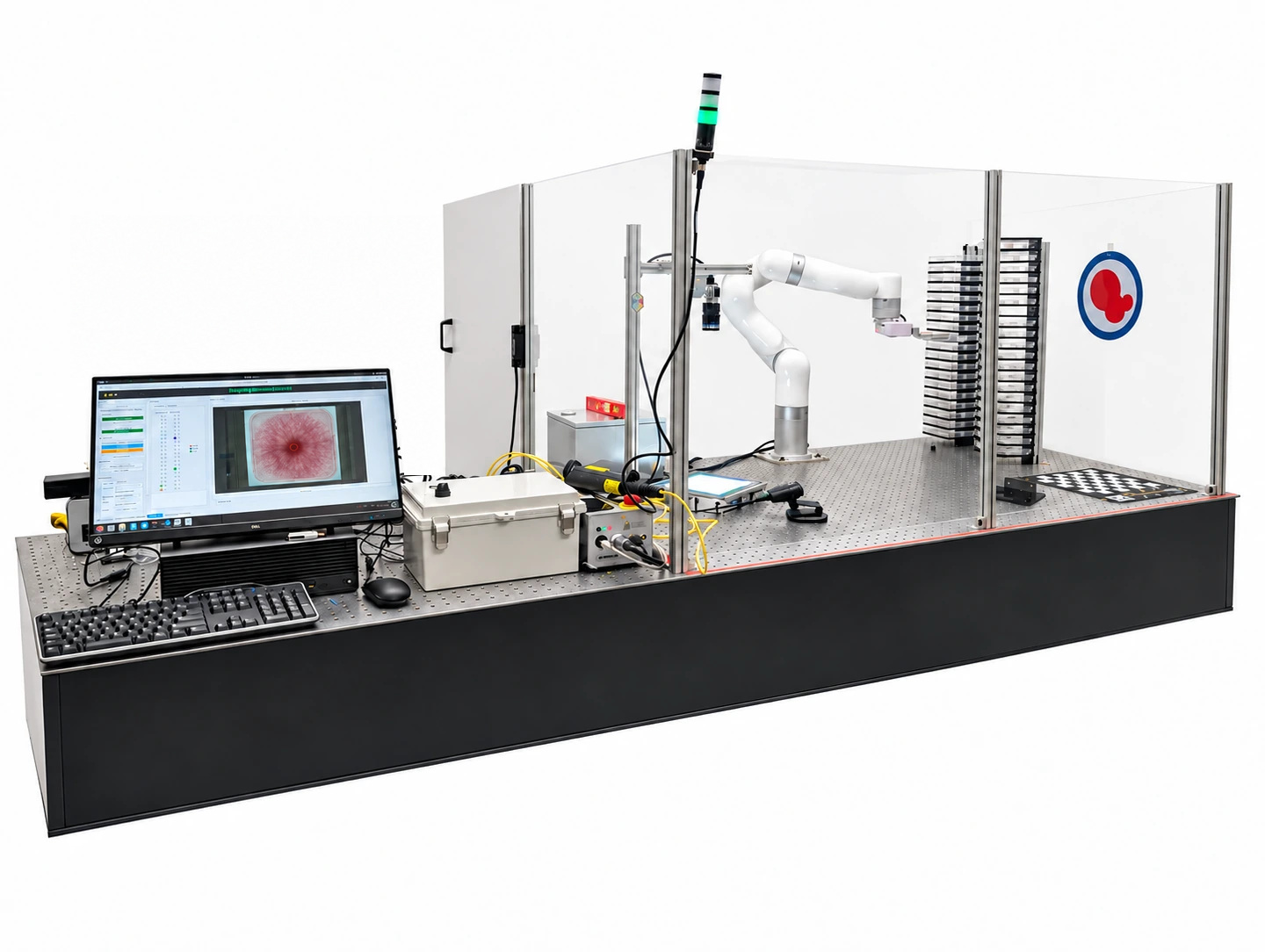
An AI-ready benchtop Petri dish imaging system. Each base configuration includes a cobot arm, five shelf racks, and a 20 MP Basler RGB imaging station with backlight. Choose 440 mm or 700 mm cobot arm reach; an enclosure with door interlock and a safety controller with arm switch, reset, and status light are standard. Included MCP and CLI interfaces provide real-time access to acquired images and instrument controls.
Why PheneMachine? A phene is an elemental unit of phenotype—one of the individual characteristics that together describe an organism. Functional phenomics connects these phenes to biological function and performance. PheneMachine helps researchers capture images and turn them into measurements for understanding biological traits. Read Larry York’s functional phenomics paper (2019) ↗
Standalone imaging
Need imaging without the robotic workcell? The standalone PheneMachine Imager is available to customize for your research needs. Contact us to discuss your requirements and request a quote.
Request an Imager quote ↗Benchtop base configurations
Both base systems include the cobot arm, five shelf racks arranged in a semicircle, and a single RGB imaging station. The 440 mm and 700 mm measurements refer to cobot arm reach, not the overall system size. Standardized plate adapters accommodate 100 mm round or square Petri dishes. The 440 mm-reach arm serves 10 dishes per rack (50 total); the 700 mm-reach arm serves 20 per rack (100 total). For best imaging results, we recommend plates without grid lines or markings. Other plate sizes are available through customization. An enclosure with door interlock and a safety controller with arm switch, reset, and status light are standard.
| Specification | 440 mm cobot arm reach | 700 mm cobot arm reach |
|---|---|---|
| Base price (USD) | $24,900 | $29,900 |
| Cobot arm reach (included) | 440 mm (Lite 6) | 700 mm (xArm 5) |
| Base format | Benchtop | Benchtop |
| Cobot arm ambient range | 0–50°C (32–122°F) | 0–50°C (32–122°F) |
| Dishes per rack | 10 plates | 20 plates |
| Total base capacity | 50 plates | 100 plates |
| Shelf racks (included) | 5 semicircular shelf racks | 5 semicircular shelf racks |
| RGB imaging station (included) | 1 RGB station | 1 RGB station |
| RGB camera | 20 MP Basler | 20 MP Basler |
| Imaging backlight | Included | Included |
| Plate orientation | Flat or angled | Flat or angled |
| Included computer | Linux PC | Linux PC |
| Included local storage | 1 TB | 1 TB |
| Acquisition software | Scheduling & imaging GUI | Scheduling & imaging GUI |
| Agent interfaces | CLI & MCP server | CLI & MCP server |
| Image access | Real-time access to captured images | Real-time access to captured images |
| Enclosure & door interlock | Included | Included |
| Safety controller | Arm switch, reset & status light | Arm switch, reset & status light |
| Included warranty | 1 year | 1 year |
Included at either base price: cobot arm, five shelf racks, one RGB imaging station with backlight, Linux PC, 1 TB storage, real-time image access, imaging/scheduling GUI, and CLI + MCP interfaces. An enclosure with door interlock and a safety controller with arm switch, reset, and status light are also standard. The mobile cart, custom image analysis, and additional software are optional upgrades or separately quoted services; installation safeguards require site-specific review.
Request a configuration quote ↗Included in the base platform
PheneMachine Workcell is purpose-built around petri dish presentation at a dedicated RGB imaging station.
A single RGB station is included in both base configurations for visible-light petri dish imaging.
Choose the sample orientation appropriate for your workflow and imaging geometry.
Five racks arranged around the cobot arm offer 50 total positions (10 per rack) with 440 mm arm reach, or 100 positions (20 per rack) with 700 mm arm reach.
Built for connected laboratories
Both benchtop models include a Linux computer, imaging and scheduling GUI, and an MCP server plus CLI for programmatic access to newly acquired images and instrument controls. Your scripts or AI agents can integrate the system into larger autonomous laboratory workflows, while routine imaging does not require an AI service.
The supplied Linux PC runs the imaging system's control and acquisition software, with 1 TB of local storage included.
Control the system, configure imaging sessions, and schedule acquisitions through the included graphical user interface.
Agent-ready interfaces provide real-time access to captured images and instrument controls. Connect your scripts, existing research software, or AI agents without a proprietary AI subscription.
Fully unlocking robot movement is possible, but invalidates the warranty.
We consult on segmentation models and provide basic segmentation, colony counting, colony morphology, and colony spectral features, with suitable imaging hardware and data. Further model development, software customization, and research-specific AI or autonomous phenotyping workflows are available by quote. The included MCP server and CLI make PheneMachine Workcell agent-ready; independent experiment planning, analysis models, decision-making, and end-to-end autonomous workflows require separately scoped software, safety measures, and validation.
Analysis that grows with your experiment
We provide basic image-analysis packages and work with customers toward trained models when their samples and research questions require more specialized segmentation.
Separate foreground objects using intensity or color thresholds. Measure object counts, projected area, and color features within defined regions. Review masks and tune settings for your lighting, background, and samples.
Combine repeat acquisitions with per-image measurements to examine growth trajectories and treatment responses. Preserve original images so segmentation and analysis can be reviewed or repeated as methods improve.
For complex backgrounds, touching objects, or specialized traits, we can scope representative image collection, annotation, model training, and validation on held-out samples. Model development is a collaborative service, not a guaranteed pretrained solution for every sample.
Analysis packages and trained models are quoted separately from the base acquisition system. RGB color features describe visible appearance; hyperspectral features require suitable optional hardware. Threshold-based counts represent segmented objects and may differ from biological colony counts when objects merge.
Discuss your samples and analysis needs ↗Join the next era of phenotyping
Phenotyping built for agents from the ground up. We’re inventing the science of agentic phenomics. Join us.
Acquire images on a schedule. Access newly captured images through the included Model Context Protocol (MCP) server. Let your own agents or automation software connect image acquisition to experiment management and downstream analysis.
Agent-ready means accessible data and control interfaces—not a claim that the base system independently designs experiments or operates an entire autonomous laboratory without integration.
Join us — explore a collaborationOptional upgrades
Start with either base system and select upgrades for your research needs. Prices below are additions to the base system price (USD).
Upgrades are configurable additions. We will confirm final layout, compatibility, scope and combined pricing in your quote.
Custom configurations · Request a quote
We can discuss robots on linear rails for large-scale plate handling, with custom layouts supporting up to 2,000 positions depending on the system design. Custom configurations can include a hyperspectral camera, plate hotels, agar sampling, delidding, local AI stations, and software customization. Laser scanning, additional lighting or sensing stations, analysis, and agentic workflows can also be scoped alongside the hardware.
System safety
Collaborative-style robot arms offer configurable collision detection and reduced-speed operation. These features can mitigate risk, but safety depends on the entire installation—including plate holders, pinch points, rack geometry, access, and operator behavior.
Collision detection can cause a robot to stop when a configured threshold is exceeded, while lower operating speeds can reduce potential impact severity. Neither prevents all first contact, trapping, or crushing hazards, and neither should be assumed to provide a certified protective function without validation.
Both benchtop base systems include an enclosure with door interlock and a safety controller with arm switch, reset, and status light. Infrequent access, trained staff, defined procedures, and keeping people outside the working envelope can inform a site-specific assessment, but do not automatically remove the need for guarding, interlocks, or other protective measures.
The standard enclosure includes a door interlock connected to the safety controller. An open front with a safety light curtain can replace the door for +$2,000. Design and verification of protective functions depend on the application.
Robot, end effector, dishes, equipment, mounting and access must be evaluated together through a documented risk assessment. Applicable references include ISO 10218-1:2025, ISO 10218-2:2025, ANSI/A3 R15.06-2025, and ISO/TS 15066:2016 for collaborative applications. These are design and assessment references, not claims of independent certification or system-wide compliance.
Site requirements
The standard format is benchtop. The Lite 6 and xArm 5 robotic arms have a manufacturer-specified ambient operating range of 0–50°C (32–122°F). Systems may be installed in climate-controlled rooms or suitable incubators following a site review of temperature, humidity, condensation, ventilation, clearances, electrical requirements, and the limits of all integrated components. The 0–50°C figure is an arm specification, not a whole-system environmental rating.
Configuration & pricing
Tell us about your plates, imaging conditions, capacity goals, and any requested integrations.